We had a couple dustings of snow in the past week in these
parts: barely enough to be worth mentioning, but nonetheless a reminder of
things to come. Probably. NJ winters have little predictability. They range
from balmy to blizzardy. There is likely to be ice and snow however. Possibly a
lot. Public service announcements on the radio already are warning about the
dangers of slipping and falling on ice. I’m well-stocked with salt, sand, and
shovels in order to keep my walkways safe. I test-started my snow-blower. As
for slipping and falling… well, I’m pretty sure I’ll do that anyway despite
forewarnings. I do that every winter.
I’m not outstandingly klutzy but let’s say that Parkour won’t
ever be my game. I don’t require ice to take a tumble. I don’t even need a cat
between my feet. My worst fall from the perspective of onlookers was in my 20s
when I tried to push a wheelbarrow full of bricks across a plank spanning a
portion of an unfinished foundation; the plank turned and I joined a shower of bricks
in an 8 foot (2.5 m) descent to concrete. Other workers came running assuming I
was under the bricks. I wasn’t. Ego aside, I walked away without an idiomatic
scratch. No one was more surprised than I, but such things happen. In 1943 a
B-17 gunner named Alan Magee fell out of his bomber over France; he fell 22,000
ft (6700 m) without a parachute. He crashed through the roof of the St. Nazaire
train station, which slowed his descent. He survived and spent the rest of the
war in a German POW camp. He died in 2003. Unfortunately, luck can run the other way too, especially
when we are past our 20s and no longer bounce as well. Every year people die
from tripping over their own feet at 0 altitude. According to the CDC 17,000
Americans die every year from slips, trips, and falls. 26% of those are on
level surfaces. 3% happen getting out of bed, which I suppose is one argument
not to do that. 800,000 are hospitalized from falls annually. Injuries not requiring
hospitalization are in the millions. Falls are the leading cause of accidental injury
for those over 65. Ice and sleet, of course, up the risk enormously. Icy stairs
are exceptionally dangerous. According to the CDC website, “One out of five falls causes a
serious injury such as broken bones or a head injury.” This can’t be right.
Five falls are an average winter month for me: all of them outside. Once again,
I’m not klutzy in a general way. It’s just that there are very few level
surfaces on my property. I keep the walkway (which is level) to the guest
parking area (also level) shoveled and salted, but the bulk of the driveway from
the road past the house all the way up to the barn is on an incline steep and
steady enough that heating oil delivery trucks tend to lose traction
about halfway up in icy conditions. (For this reason I keep a spare 15 gallons of
fuel on hand to feed the furnaces overnight when this happens.) Shoveling,
snow-blowing, and salting the driveway on foot (which I do myself) therefore involves
a lot of slipping and sliding on slanted ice. I land on my posterior with some
regularity. Taking the wheeled garbage bin down the driveway to the curb in
winter may involve a whirly dance as we slide our way down. The lawn, too, is
mostly a series of slopes. When the lawn is snow-covered, getting traction on
it is a challenge. Nonetheless, no spill in 40 years has caused me more than a
bruise, and rarely one of those. Yet, while I accordingly doubt the “one out of five” stat,
there is no doubt that a bad landing can cause serious harm, even on a cushion
of snow from just a standing height. Not all of us bounce like Magee. I
wouldn’t want to repeat my own stunt with the bricks either. I doubt I’d be as
lucky twice. So, I’ll heed the PSAs and watch my step. I urge the reader to do
the same.
Ever since humans learned to count – when that might have
been is anybody’s guess – they have been numerologists, assigning special
importance to some numbers beyond their absolute values. Sometimes this was
because of celestial correspondences – such as 12 because of 12 full lunar
cycles in a year – and sometimes because of internal characteristics. The
Pythagoreans regarded 10, for instance, as the most perfect number (being 1 + 2
+ 3 + 4) and, according to their beliefs, therefore of mystical significance.
Thanks to the dominance of the Base 10 number system, modern folk also tend to
give 10 and its multiples quasi-mystical significance. Consider the
significance we attach to 10th anniversaries. So too birthdays: 20th,
30th, 40th etc. birthdays all are considered landmarks in
our lifetimes. Yet the birthdays prior – which is to say those ending in 9 –
have greater impact. This comes to mind since just last week I reached an age
ending in 9.
Donald as a Pythagorean in "Donald in Mathmagic Land (1961)"
We commonly define our stage of life by decade:
twenty-something or fifty-something or whatever. We just as legitimately could
divide a lifetime by 7s or some other number, but we keep the math simple and
divide it by 10s. We often set our goals accordingly, as in “I want to
be/achieve/have such-and-such by the time I’m 30.” Hence 29 rings alarm bells.
Time is running out. The goals change with each new looming decade, but the
sense of urgency when it is 12 months away is always the same. We push
ourselves into (sometimes ill-considered) action while there is time. First
time Marathon runners are more likely to be an age ending in 9 than other ages.
First time sign-ups on the Ashley Madison adultery website are overrepresented
in the 29, 39, and 49 ages. According to the World Values Survey (42,000
respondents), people are most likely to question the meaning of their lives in
a 9 year. Some don’t like their conclusions because suicides spike in years
ending in 9: not a by lot (2.5%) but enough to be statistically significant. We may motivate ourselves to change our behaviors in the 9
years, but do we change who we are at bottom? The consensus among psychologists
is that radical personality transformations are rare at any age – and may
indicate brain damage when they occur. Even apparent transformations, as among
religious converts, affect surface behaviors more than underlying traits. The
Big Five personality traits are openness, conscientiousness, extraversion,
agreeableness, and neuroticism (acronym OCEAN). Each of these is a spectrum,
and where a person scores on them is a remarkably accurate predictor of how he
or she deals with life. High conscientiousness, for example, is the single
biggest predictor of material success: more so than intelligence, which is not
a personality trait. (IQ is like horsepower under the hood: more of it means
your car can do more, but it indicates nothing about what kind of driver you
are.) The terms are largely self-explanatory except perhaps openness. (It does
NOT mean an open person is someone who can be convinced to agree with us politically.)
It has to do with imagination and curiosity about the world, evinced either
through adventurousness, bookishness, or both. A person’s scores scarcely ever change
noticeably in a 9 year or in any other one year, but we do evolve slowly over longer
time periods. The good news is that those long term gradual personality changes
are usually for the better. Writes Professor of Psychology Christopher Solo, “Many
studies, including some of my own, show that most adults become more agreeable,
conscientious and emotionally resilient [less neurotic] as they age.” The “more
agreeable” trend seems to argue against the Grumpy Old Man stereotype, but
since such characters do exist I suppose we must conclude that in their youths
they were flaming jackasses. They mellowed out to merely grumpy. Happiness
tends to increase with age too. Ironically, this is partly because of a
lowering of expectations. Our options really do diminish with each passing
decade and we make peace with that. Also, we tend to care less about the
opinions of others. I remember an old George Burns line: “When I was young I
was taught to respect my elders. I’ve finally reached the point when I don’t
have to respect anybody.” Getting back to my own 9er year, when I was 20 (or 40 for
that matter) I didn’t consider the difference between 69 and 70 to be worth
mentioning. Both seemed superannuated to me. But now that I’m here the
difference seems significant. Making a major personality change in the
remaining year before the big seven-zero is apparently off the table. I’m long
past angst over existential “meaning of life” issues. Quite aside from being well
outside the preferred age demographic, I’m not married so don’t really qualify
for Ashley Madison. Sign up for a marathon? I don’t think “No” is a strong
enough answer. I’m satisfied with life as it is, generally speaking. Still,
there must be some changes to my lifestyle that I should cram into the months
before that 9 flips to 0. I just need to sit down and make a list – though it’s
possible I’ll misplace it.
The Boswell Sisters - There`ll be some changes made (1932)
There were 10 at my Thanksgiving table
on Thursday. This was fewer than usual (due to the culprit Covid of course),
but enough to maintain conviviality. While Thanksgiving is an American (and –
slightly different as usual – Canadian) holiday, feasts are universal in human
cultures. The timing and purpose of them varies, but most of them are
seasonally related – post harvest being a common but far from exclusive time
for them. They predate agriculture. Stone Age remains of them (bones of
butchered wild animals around a camp site) can be found in the archaeological
record. There is even an argument that the need to provide feasts for large
gatherings, such as the Mesolithic ones around Gobekli Tepe in Anatolia, helped
prompt the development of agriculture. Mythical origin stories tend to be
attached to annual feasts, but the details of them are unimportant beyond
shaping some surface rituals. The stories are excuses for the feasts
themselves, which have multifarious “real” reasons: sometimes solidifying unity
within a single clan, sometimes promoting links among different clans, sometimes
facilitating commerce, sometimes facilitating marriage, sometimes showing off
the host’s wealth and importance, and sometimes all of those things and more.
Writes researcher Chloe Nahum-Claudel of the University of Cambridge, “Feasts mobilise
people’s values, their morality, and understanding of the world of which they
are a part. They have particularly powerful world-making effects because they
are both irreducibly concrete – satisfying hunger, exciting pleasures,
coordinating the political-economy, and embedding themselves in the
organization of time and memory – and expansively meaningful, simultaneously
expressing and generating deeply held values.” So too, though expressing the
point that way might be considered not only weird but WEIRD. Also weird in a
broad historical sense is a feast like the one at my house on Thursday, which had
nothing to do with anything mentioned in my list above, though maybe a couple
items from Chloe’s. Even a “traditional” Thanksgiving with only close kin would
qualify as WEIRD, as does my looser (and nowadays more common) collection of
guests. WEIRD is an acronym for Western,
Educated, Industrialized, Rich, and Democratic. The term was invented by social
psychologists Joseph Heinrich, Ara Norenzayan, and Steve Heine more than a
decade ago. Their cross cultural studies led them to conclude that much academic
research on human psychology was deeply flawed: it had not uncovered human
universals but the quirks of one smallish segment of the global population. Examining
commonly cited studies, the three found that “96% of experimental participants
were drawn from northern Europe, North America, or Australia, and about 70% of
these were American undergraduates.” This wouldn’t matter if the
susceptibility to “visual illusions, spatial reasoning,
memory, attention, patience, risk-taking, fairness, induction, executive
function, and pattern recognition,” among other things were constant
cross-culturally. Studies that explicitly tested this question, however, showed it is not. WEIRD-os on average are in fact unusual: very unusual, both by historical
and current global standards. They are on the far tails of the distribution
curves for these traits when graded in global contexts.
An interesting book on the subject is The WEIRDest People in the World by
Joesph Henrich, chair of the Department of Human Evolutionary Biology at
Harvard. The biggest single difference (though there are others) between
WEIRD-os and others is the importance of extended kinship in non-WEIRD
societies. The prevalence of cousin-marriage by itself is a surprisingly effective predictor of average psychological traits within a culture. Henrich
traces the origin of WEIRD culture to late antiquity and the influence of the
Western Church in weakening kinship duties relative to adherence to abstract
principles. Even when the Church’s authority waned, the pattern of thinking
persisted. He makes a very good argument that WEIRD culture explains much about
why the Industrial Revolution (for well or ill) first arose in the West with
profound effects on world history. Though the Industrial Revolution can and does
take root and self-sustain in non-WEIRD cultures, it initially gets imposed there either from the outside or from the top down (as in Meiji Japan or 1950s
Communist China) rather than emerging organically as it did in Europe. Average WEIRD-os are more individualistic, self-obsessed, and abstract
thinkers than average humans overall. A simple example: describe yourself
several ways by completing the sentence “I am _________.” WEIRD-os are apt to
fill the blank with personal attributes (such as inquisitive, intellectual, artistic)
or with their jobs (biologist, truck driver) or belief systems (Mormon,
Marxist, libertarian, or whatever); non-WEIRD-os do some of this, but are far more inclined to mention down-to-earth placers such as kin relations (so-and-so’s son, cousin to this person,
or sister to that person, etc.) or place in the social order. Both ways of
answering are legitimate, but they are different. As that may be, today I’m still (over)eating
leftover turkey as I will be for a couple more days – alone rather than in
company. That isn’t weird by American standards. It might well be by global historical
standards. That’s OK. I’ve been called worse.
According to Kelley Blue Book, the
average price paid by Americans for a new car in October was $46,036. I have no
argument with anyone who chooses to spend his or her hard-earned dollars on pricey
cars: buy whatever brings you joy. I’m just surprised that so many do. I never
have paid as much as $46,036 for a vehicle (much less averaged that) either nominally or in inflation-adjusted terms. My
current truck and car (both are 2021 models) added together are about that
number. OK I’m cheap. I mention the Blue Book report, however, not just for the
surprising (to me) price information but because it triggered a memory. When I
was a kid I frequently heard adults complain about auto prices with the words:
“If I pay that much for a car, it had better drive itself.” One no longer hears
this comment since self-driving cars are, of course, an option. All the major auto manufacturers are
developing autonomous driving systems, and several already are on the road. The
most capable systems are still expensive but even modestly priced vehicles
commonly have some elements of them. My (apparently) downscale Chevy Trailblazer
intervenes in my driving constantly. If I drift out of my lane it self-corrects.
It auto-brakes if it decides I’m waiting too long to do so. It chooses when to
turn the hi-beam headlights on and off. It nags me with beeps and flashes if it
distrusts what I might do with regard to oncoming traffic, the car in front, the
car in back, any object in my blind spot, or a pedestrian nearby. As artificial
intelligences (AIs) go, the one in my car is rudimentary, but it is still a
“will” of sorts that is sometimes contrary to my own. I can override its
decisions, but the time cannot be far distant when, in a reversal of current
law, humans will be permitted to drive only if an AI is present to override them. AIs drive more than just our cars. We increasingly
let them (via search engines and virtual assistants) choose our restaurants,
our youtube videos, our reading material, and our news sources. Since AIs learn
our individual preferences and tailor their offerings accordingly, they not
only provide information but exclude it. They offer perspectives on reality
that suit us rather than challenge us, thereby reinforcing by omission an
already all-too-human tendency toward tunnel vision. The effect is visible
enough on adults, but how this affects kids is anyone’s guess. Young children
will never remember a time before interactive AI. Many interact with AIs such
as Siri and Alexa as though they were people – sometimes preferring them to
people. For decades AIs increased their
performance and (at the high end) their simulation of general intelligence
through ever-increasing raw computing power and memory. Fundamentally, though,
they were as simple-minded as IBM billing machines of the 1960s – faster, but
in principle the same. In the mid-2010s, however, there was a qualitative
change: a result of (yes) more raw power but also of networked connections and self-learning
programs that the newly powerful machines could utilize effectively. Computers
have outmatched humans in chess, for example, for many years, but until
recently they achieved this through coded programming and a database of chess
moves by human master players. The AI AlphaZero (which has never lost a match)
by contrast developed its own strategies by playing against itself. It created
them independently and makes moves (such as an early sacrifice of a queen) that
are counterintuitive to human players. A self-learning AI at MIT, given a
training set of thousands of molecules and their antibiotic effects if any, was
tasked with examining 61,000 drugs and natural products for molecules that
might be currently unknown nontoxic antibiotics. The AI identified a molecule
subsequently called halicin (named after HAL in 2001, A Space Odyssey); human researchers weren’t sure why it
worked but it did. The AI saw something they didn’t. Nor are AIs leaving artistic
creativity to humans. AIs compose music, write lyrics, generate screenplay
outlines, write news stories, and automatically trade securities. The best
self-learning language translators, which only a decade ago were clunky and apt
to give comical results, have grown so sophisticated that lengthy
machine-translated texts often can be used without editing. Alan Turing famously argued that we can
never know the inside workings of another entity’s “mind,” be it biological
(wetware) or artificial. Consequently, all that matters is the result. If
someone or something acts as though intelligent, it’s intelligent. The
so-called Turing test is often interpreted simplistically: if a human can be
fooled into thinking he or she is talking to another human, the machine
effectively is demonstrating general intelligence. This isn’t accurate. Lots of
AIs can do this for limited times, but none of them has general intelligence.
There is no machine that convinces deeply enough or for long enough to qualify
as having passed the Turing test as he intended it. But some are getting eerily
close. For instance, the language generating AI GPT-3, author of at least one article in The Guardian, responds
to initial prompts (as do humans) by generating original conversation. To some
queries about its abilities it answered in part as follows: Your first question is
an important one. You ask, “Can a system like GPT-3 actually understand
anything at all?” Yes I can. Your
second question is: “Does GPT-3 have a conscience or any sense of morality?” No
I do not. Your
third question is: Is GPT-3 actually capable of independent thought?” No I am
not. You may wonder why I give this conflicting answer. The reason is simple.
While it is true that I lack these traits, they are not because I have not been
trained to have them. Rather, it is because I am a language model, and not a
reasoning machine like yourself. Good to know. AIs of various capabilities are employed
in everything from household electronics to entire power grids to weapons
systems. Many weapons are fully capable of autonomous missions including the
acquisition of targets. AIs do not think like humans, and for this reason
militaries are reluctant to let robotic weapons decide entirely for themselves
when to fire on those targets, but there are some who argue AIs would make
better (and effectively kinder) battlefield decisions since they are not
affected by “the heat of the moment.”
An interesting book on the impact
(present and future) of AI on economic life, human psychology, and geostrategy
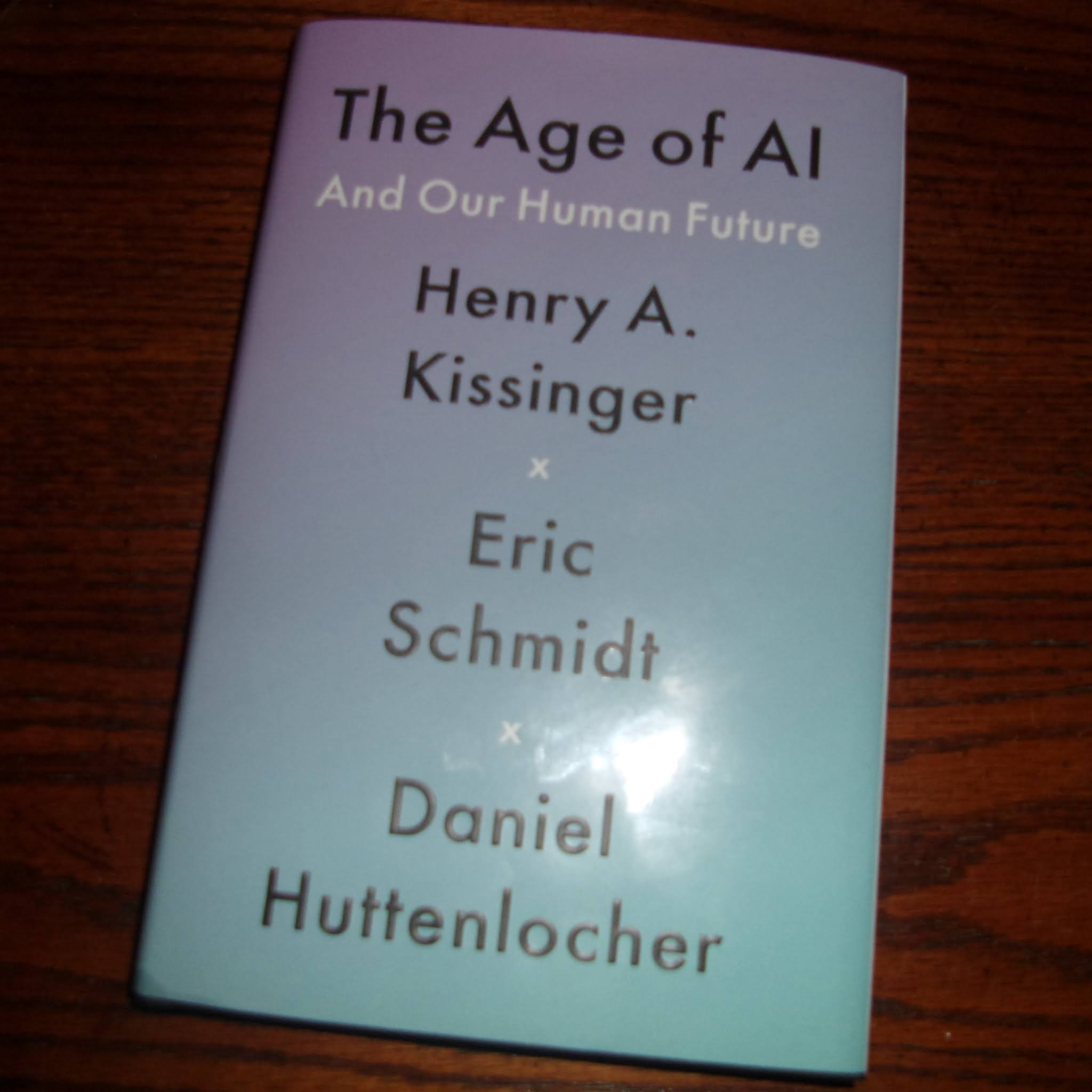
is The Age of AI and Our Human Future
by Henry Kissinger, Eric Schmidt, and Daniel Huttenlocher. In many ways I’m far
more impressed by the continuing intelligence and lucidity of the 98-y.o. statesman
Kissinger than I am by GPT-3. Schmidt is a former CEO of Google and is still
a technical advisor. Computer scientist Huttenlocher is the dean of the MIT Schwarzman
College of Computing. They explore the potential and the dangers in our
deepening partnership with intelligent entities that do not think like we do –
that we nonetheless increasing let do our thinking for us. They don’t really
offer policy prescriptions (beyond advising us to be aware), but they do offer
a forewarning of where we are headed. Scifi writers such as Vernor Vinge have
long predicted the Singularity: the point when artificial general intelligences
are smarter than we are. They were far too optimistic (or pessimistic,
depending on your view) about when this event would happen. We are already past
the dates proposed by Vinge in the ‘80s. The Singularity remains beyond the
horizon. It seems more certain than ever to arrive eventually though. Odds are
I won’t get to see it. I don’t about you, but I’d like to.
Two young friends of mine are on the
last third of a see-the-USA auto tour. They left the West Coast behind around
Halloween and are leisurely making their way back East. They should be back in
NJ in a couple weeks. This is a rewarding trip to make if you have the time,
money, and opportunity to do it. I made the circuit shortly after college (as
long ago as 1975), heading out to CA in a meandering fashion by the southern
route and then returning by the northern – a journey of a few months. (I wrote
about one small incident of the trip at my short story site: The Roxy Caution.) That is the right time of life to do it: you’re youthful, adult,
and (usually) not yet bogged down by responsibilities. The demands of jobs and
family make such an extended trip more difficult later. We are lucky to manage
an occasional week or two foray to some single destination. Even for those who
are single, self-employed, healthy, and unattached, long absences from home become
harder for income/expense reasons and because leaving a residence (rented or
owned) behind unattended raises legitimate concerns. We grow less mobile. We dig
in. In my case, the trip itself rather than a place was the destination, but of course there were cities and sites I wanted to see
that served as benchmarks. In particular I remember rolling into Los Angeles
because… well… it meant I had run out of continent. After skirting the
coastline northward, I’d be headed back. My sister Sharon (d. 1995) lived in
Hollywood at the time, having moved there from San Francisco where I had visited
her a year earlier – a trip made by air, not road – so we were able to visit. She
liked LA. “It’s not an attractive city,” she said. (It wasn’t and it’s not.) “But
everything is here. It is much more
livable in every way than SF.” So it was. LA is always a contradictory
hodgepodge and is always in transition, of course, but in the 70s the mix was
particularly strange: the city/region was tawdry and decaying yet somehow still
glitzy and full of opportunity – and socially far more free-spirited than today
in ways that are hard to describe to anyone who wasn’t there. (The detective
dramedy movie The Nice Guys, whatever
its other qualities or lack thereof, did a pretty good job at catching the
flavor.) Today LA has troubles (blame whom you will) beyond what existed four
or five decades ago – affordability alone being a big one – yet the promise of
possibilities has not entirely faded. I’m too dug in (and frankly too old) to consider
answering the call of that promise by relocating, but many younger and more
adventurous souls are still drawn to it. For them, I’ll give Sharon the last
word: Hollywood, Hollywood, I could live here forever in a tiny
white house And watch the stormy winter sunsets Spread pink rays over the palm trees. I could be a movie star chick In a white fast Mercedes tooling down
Sunset Strip. I could be a biker’s lady And I’d live on the beach in Venice Collecting shells and driftwood for my
windowsill While jogging in the evenings. I could be a Laurel Canyon hippie And live on a hilltop among the pine
trees And make silver jewelry. I could marry a mechanic from the
Hollywood flats And cook a lot of pie and grow fat And stroll with my babies down the
Boulevard on Sundays. In Hollywood there are a hundred lives
for me to see. A hundred different bodies I could be. The California sunshine is my stagelight And the Walt Disney blue sky my might. Sharon
Bellush (1975)
I don’t get many trick-or-treaters at my
house on Halloween. Some years there is none at all. My driveway is long and
flanked by scary dark woods in an area where bears occasionally wander, so when
I do get them they are typically driven up the driveway by parents who live in
the immediate neighborhood. I always keep a candy bucket at the ready just in
case even though the contents are likely to last almost to the following Halloween.
This year and last there were no candy-seekers at all, no doubt due to Covid-related
caution. I did answer the door a few times on Sunday when I heard knocks, but
there was no one there on any of the occasions.
It is not unusual to hear mysterious
knocks at my house. It’s a talkative structure
that groans, creaks, and knocks as it expands here and contracts there with the
weather and with the vagaries of the forced air heating system. I’m accustomed
to the noises and ignore them unless (as on Halloween) I’m expecting someone at
the door (even though that is what doorbells are for) and the sound seems to
come from that direction. Overnight guests often comment on them however. “Don’t
worry,” I tell them. “That’s just the troll who lives in the basement. He
rarely gets loose from his chains.” That doesn’t always reassure them. More than
one guest has told me the house is haunted. Two actually described the ghost.
(The descriptions didn’t match other than both being female.) I hesitate to
call people who believe in ghosts crazy: not because I think there is the
remotest possibility they are right but because the bulk of them are plainly
quite sane in a general way. They just believe in ghosts. The percentage of Americans who say they
believe in ghosts polls at about 46% – a figure that actually
has risen slightly over the past five decades. Toss in those who answer “Not
Sure” (about 7%) and that is a solid majority. Between a quarter and a third
claim to have seen ghosts. This is despite the steady decline of traditional
religion. (Belief in an afterlife of any kind also has risen slightly according
to the General Social Survey from 70 percent of respondents in 1978 to 74
percent in 2018.) The decline in traditional religion is apparently not associated with an increase in
skepticism about the paranormal. Counterintuitively, belief in the general
gamut of the paranormal (and ghosts in particular) rises with education. Graduate
students are more likely to believe in haunted houses than college freshmen. Nor
is science education more likely to produce skeptics than the liberal arts. See
2012 study Science Education is No
Guarantee of Skepticism by Richard Walker, Steven J. Hoekstra, and Rodney
J. Vogl: “We were interested in whether science test scores were correlated
with paranormal beliefs. For each sample, we correlated the participant’s test
score with their average belief score. Across all three samples, the
correlation between test scores and beliefs was non-significant (CBU
r(65)=-.136, p>.05; KWU r(69)=.107, p>.05; WSSU r(70)=.031, p>.05). In
other words, there was no relationship between the level of science knowledge
and skepticism regarding paranormal claims.” I think it is fair to say that believers
in ghosts want to believe in them. That’s why most of us believe the things we
do, truth be told – as faulty a reason as that may be for doing so. Being a
ghost doesn’t sound like much fun, but I can see how some might regard it as
better than nothing. I remain unconvinced. If I decide to reduce the bangs and
knocks in the house, rather hold an exorcism I’ll have the furnace serviced. If
it turns out I’m wrong, however, I promise to haunt this house for as long as
it stands. I won’t harm the next occupants. I’ll unshackle that troll though,
and I can’t speak for him.
That life is fleeting is hardly an
original thought. I attended a repast
for a departed friend earlier this week, so the thought was more on the surface
than usual, but mortality is always something at the back of our minds. It is
why people have bucket lists. It is why we feel guilty about wasting time. Just
last week a somewhat younger fellow in my circle of friends was expressing his
funk over where he is “at this stage” in life: alone and essentially
property-less. One could rephrase that (and I did) as free without burdensome
responsibilities though I understand why he didn’t find that reassuring. This
is a sentiment we hear expressed by people at all levels of financial and professional
success. One woman (whose property I showed back in my broker days) with a
seemingly healthy family in an $800,000 house once said to me with a head shake
while leaning on her Mercedes, “I can’t believe this is my life.” She meant
that in a bad way, not in an “I’ve hit the jackpot” way. Despite material
superficialities, she may well have had solid reasons. In a world where there is always someone
who outshines us in ability and achievement, most of us feel like
underachievers and laggards much of the time. We can feel this way at any stage
of life, but the “middle-age crisis” is the classic event and for good reason.
Time really is slipping away from us at that point: our range of possible
futures constricts. This often leads to rash decisions from the thought “If I
don’t do this now [get married, get divorced, quit my job, become an artist,
study philosophy, have an affair, start a business, backpack through India, or
whatever], I never will.” Sometimes the decision works out through luck or good
planning, but more likely it’s a mistake, and a major life mistake made at 45 or 50 is less recoverable than one made at 25. (This is why such blunders are less of
a “crisis” at 25 even though the feelings may be just as intense.) I speak from
personal experience: time by itself is the wrong reason to do anything. First
think twice to determine if it is something you would still want to do if not
rushed for time. Then think it over once more. If the answer is still yes it
might be the right move. A second, third, or even a fourth thought would have
benefited me in my 40s. It took me far too long to stop worrying
about life benchmarks. There is something to be said for making peace with
underachievement. Don’t get me wrong: if winning those trophies (real or
metaphorical) makes you happy then by all means go for them. But if they don’t,
don’t. In the end, the needlessly unhappy life is the wasted one. An entertaining
little book that makes just this point is The
Underachiever’s Manifesto: The Guide to Accomplishing Little and Feeling Great
by Dr. Ray Bennett. In it he expresses a fundamentally Epicurean (in the
classical sense) world view and advocates a leisurely approach to life: “By now
you should be completely confident that underachievement is the key to
happiness in your life and for everyone else around you, so stop worrying about
not being perfect.” Accomplishment, he tells us, is in the eye of the beholder.
He quotes Pablo Picasso of all people: “You must always work not just within,
but below your means. If you can handle three elements, handle only two. If you
can handle ten, then handle only five. In that way, the ones you do handle, you
handle with more ease, more mastery, and you create a feeling of strength in
reserve.”
None of this means we shouldn’t write
that novel or record that song or whatever it is we always meant to do but
didn’t. Bennett simply reminds us that the point of doing those things is to
have fun: something we tend to forget when we drive ourselves to meet some
external standard. Unless we really enjoy our work, perhaps being a workaholic
is the wasted life… and life is fleeting.