“Parasocial” is the term for one-sided relationships of the
sort we might have with celebrities: we know them (to some extent) but they
don’t know us at all. These one-sided relationships existed even in ancient
times when the only media were handwritten scrolls, statues, and word-of-mouth
rumors about the elite and famous, but they got an enormous boost with the
arrival in the 20th century of movies and recordings that seem to
bring us face to face or within earshot. Fans are known to become emotionally
attached to these well-known strangers enough to experience genuine grief when
they die. The phenomenon was examined back in 1985 by Richard Schickel in Intimate Strangers: The Culture of Celebrity
in America, a book that now seems rather quaint in today’s age of virtual
interactions on online social media where twitter posts can masquerade as actual
conversations. Most of us understand the limitations of parasocial
relationships. Those who don’t understand them form the pool from whom stalkers
emerge.
Dawn Wells (1938-2020) "Mary Ann"
A more curious phenomenon, also regarded as parasociality, is
a relationship with fictional characters. This, too, has ancient precedents.
Long before Homer’s epics were written down around 700 BCE (prior to which they
were an oral tradition) people sat around the hearth fires and listened to
bards recite stories of Troy and tales of brave Ulysses. The listeners surely
felt they knew the characters as well as they knew their own neighbors. Again,
modern media make the illusion all the more convincing. In the 1960s there was
a common debate among high school boys of Mary Ann vs. Ginger on the TV show Gilligan’s Island. Being a smart-aleck
teenager at the time, I tended to respond dismissively: “Like, you know they’re
fictional, right?” But in truth I knew exactly why the debaters debated, and
had an unvoiced opinion. Beyond the superficial level of schoolboy crushes,
people often become deeply invested in their favorite shows. They care about
the characters and what happens to them. On some level viewers regard the
characters on Friends as friends. The
prevailing opinion among psychologists is that up to a certain point this is
perfectly healthy: a normal expression of empathy. Below the most surface level
of consciousness our minds aren’t good at distinguishing between fictional
characters and real ones – assuming the scriptwriters and actors are halfway
competent. Dr. Danielle Forshee on her website says “your brain recognizes the
human emotion they are portraying and starts to feel connected to those
characters.” Also, the characters can be avatars of ourselves, and so it can be
cathartic and helpful to see them work through difficulties we’ve faced
ourselves. It can be disturbing to watch them get into avoidable trouble (by
marrying the obviously wrong person, for example) just as it is disturbing to
watch a real friend do it – or, worse, do it ourselves.
This is also why fans get so upset when book series or TV
shows don’t end the “right” way. Many shows get canceled abruptly and so have
no proper endings at all. (It’s a bit like being ghosted in real life.) This
frustrates fans but apparently not as much as deliberately crafted endings that
they don’t like. Google something like “beloved TV shows with hated finales”
and you’ll get a long list including Game
of Thrones, Dexter, Lost, Enterprise, Seinfeld, The Sopranos, and How I Met
Your Mother, among many others. Sometimes the finales are truly slapdash
and unsatisfying, but even well-crafted ones can annoy fans.
I actually like one of the most hated finales of all time: How I Met Your Mother. *Spoilers*
follow, so in the unlikely event the reader hasn’t ever seen the show, skip
this next part. The majority of fans are upset because 1) there isn’t a
“happily ever after” ending and 2) Ted reconnects with Robin after nine seasons
of the audience being told that they weren’t right for each other. Well, life
doesn’t have “happily ever after” endings. Mark Twain commented that love
affairs end either badly or tragically, and the tragic ending in HIMYM is the
way things go – earlier in this case than one might hope but frequent enough at
that age even so. Secondly, Robin and Ted weren’t
right for each other when Ted was looking for “the One” with whom to build a
home and family while Robin wanted a childless globetrotting career. Years
later, however, Ted is a widower father of grown children and Robin is successful
at her job and divorced. Their goals no longer clash but they still have a long
shared personal history. They might get on just fine. Times and circumstances
have changed. That doesn’t diminish Ted and Tracy; they were right for the kind
of life they had at the time they had it. (Besides, the point is often missed
that Ted is Tracy’s second pick; in one episode she talks to her deceased
partner whom she had regarded as “the One” about moving on.) Maybe my response is a matter of
age: I’m looking at things from the perspective of old done-that Ted, not young
aspirational Ted, but to me the ending makes perfect sense.
That I gave this matter any thought at all is a prime example
of parasociality. So, anyone at whom I snickered in high school for debating
Mary Ann vs. Ginger is fully within his rights to say to me about the
characters in HIMYM, “Like, you know they’re fictional, right?”
Among the books recently to occupy my bedtable (they serve as
my sleeping pills) was First Principles:
What America's Founders Learned from the Greeks and Romans and How That Shaped
Our Country by Thomas Ricks. Many of the political disputes that exercise
passions today have eerie parallels in the early years of the Republic, and
there is value in revisiting that history.
Today the Greco-Roman classics for most students are an
educational side note, often with scarcely more attention paid to them than an
assignment of a (totally out of context) bad translation of Aristophanes’ The Frogs in high school. In the 18th
century they were the core of education above the elementary level. All of the
Founders were deeply familiar with them – more so than with the literature of
their own time. The classical authors strongly influenced their philosophical
and political thought both directly from the original sources and indirectly
via Locke, Montesquieu et al. Hence there was an oft-voiced disdain for
democracy (a dirty word until the 1820s) because Aristotle regarded it as a
“perversion” of a constitutional republic just as oligarchy was a perversion of
aristocracy and tyranny of monarchy. The favorable description of the Roman
Republic (Consulship, Senate, Assembly) by Polybius was commonly referenced in
debates over state constitutions as well as the federal one. Also influential
was Cicero: “Statuo esse optime constitutam
rempublicam quae, ex tribus qeneribus illis regali, optimo, et populari modice
confuse” [I maintain that the best constitution for a State is that which, out
of the three general types, is a balanced mix of monarchy, aristocracy, and democracy].
18th century politicians weren’t subtle about it either: they regularly
referenced classical authors and ancient precedents in their speeches. Jefferson
admired Epicurus, which helps explain the “pursuit of happiness” line. Other authors
who figured prominently in the debates were Plutarch, Demosthenes, Thucydides,
Sallust, Xenophon, Tacitus, and Livy. Conspicuous for his absence was Plato.
Elbridge Gerry, who sufficiently mastered republicanism to devise the
gerrymander, voiced the general opinion by stating, "Plato was not a
republican." Ricks explores how this pervasively classical way of looking
at things (so often overlooked by modern historians) affected the Revolution
and the Early Republic.
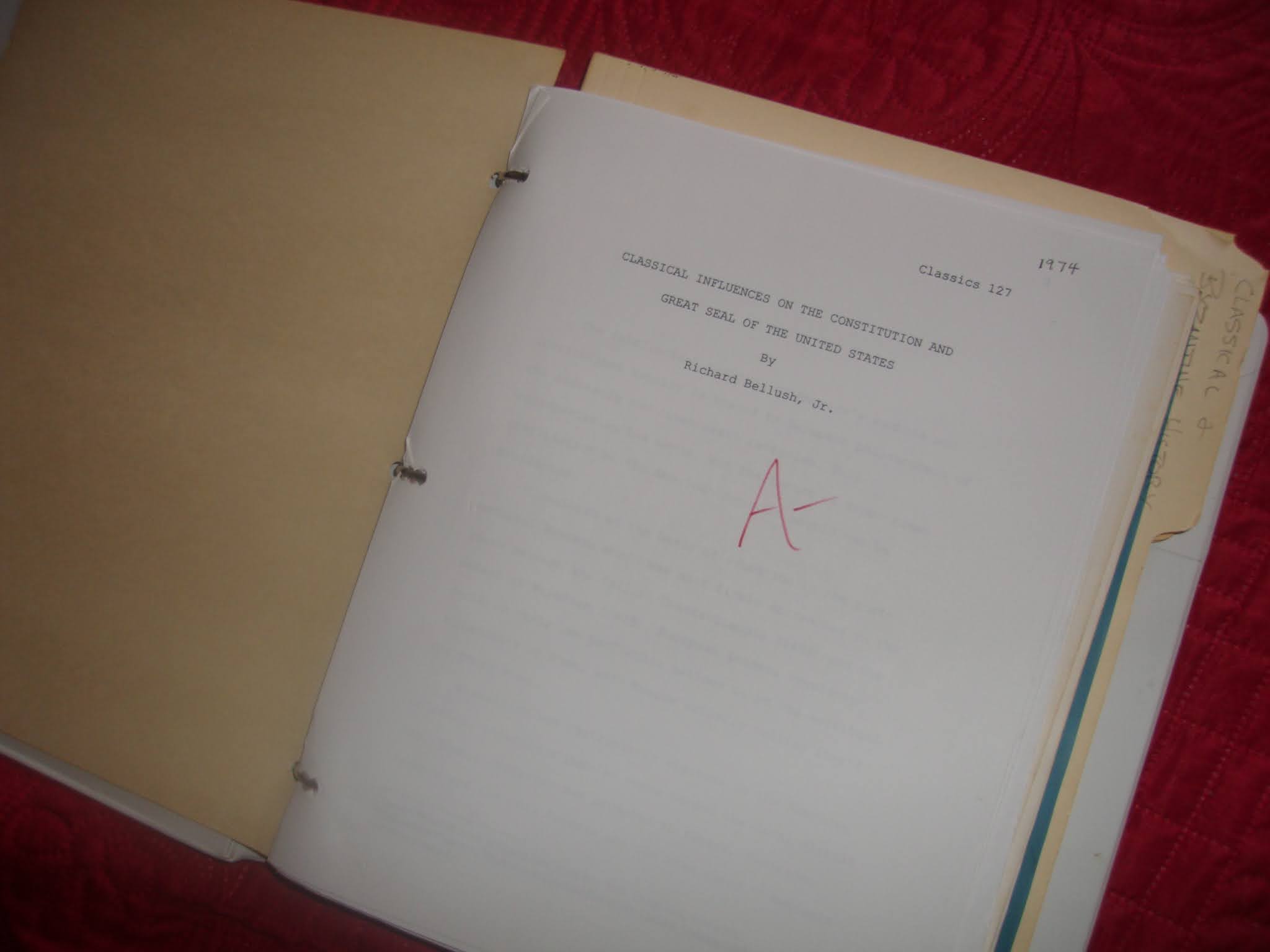
The book caught my eye in no small part because I wrote about
the same thing – far, far less ambitiously at only 14 pages – as long ago as
college. Yes, I still have some of those old papers including such page-turners
as The Impact of a Vulnerable Grain
Supply on the Imperialism of Fifth Century Athens,The Historical Writings of Procopius of Caesarea, and A History of Land Use in the Township of
Mendham though I can't imagine who'd ever want to read them.
Ricks has done his research and presents it well. He is not
oblivious to the glaring blind spots in the vision of the Founders (the failure
to address slavery being the blindest of all), but nonetheless credits them for
putting into practice a theory of rights and governance that made their
hypocrisy ultimately untenable – an unmatched achievement in the 18th
century. He rightly notes the importance of the 1800 election. There have been
other fateful elections (1860 most obviously) but without the precedent of 1800
the others wouldn’t even have taken place. With Jefferson’s victory, for the
first time there was a peaceful transition of power to an opposition party that
the losing Federalists truly believed was a threat to the nation. The event
showed such a transition was possible and that the result, while consequential,
needn’t be the end of the world.
The author closes with an epilogue of ten present-day
recommendations that he says are informed by lessons from the Founders and,
through them, from the Greeks and Romans they chose as their mentors. Some of
the points are unexceptionable but others simply don’t follow from his history
of founding principles – or at least one could use similar sophistry to argue just
the reverse. That is not to say his modern-day views on health care funding and
the like are wrong, just that they are not derivable from Constitutional first
principles. They are perhaps not incompatible with them (well, a couple
actually might be) but then neither are opposite positions (well, a couple
actually might be). There is a tendency (also dating to the Early Republic) to
try to achieve by Constitutional interpretation what cannot be achieved by
legislation; this often requires reading words into the text that simply aren’t
there. It’s a political maneuver used by any side that thinks it has a shot of
winning a court decision, but it should be recognized as such rather than as a dispassionate
analysis of Constitutional principles, classically derived or otherwise.
What Ricks doesn’t mention is another takeaway from classical
history, particularly of the Roman Republic, which many of the Founders were so
keen to emulate. Extreme factionalism in the Republic, fueled by ambitious
politicians exploiting class fears and grievances, led to civil war: not once
but repeatedly. An end was put to this only by Augustus Caesar, and then only to
be replaced by non-ideological internal wars among generals. (Rome under the Principate
never did adequately solve the peaceful succession problem.) Americans emulated
such factionalism down the path to civil war once. It would be best not to do
so again.
11
days after the solstice is a strange day to start the New Year. The designation
of a New Year’s Day in any calendar system is ultimately arbitrary, of course,
but calendars had their origins in Neolithic times from the tracking of the
phases of the moon and the (apparent) motion of the sun; accordingly, ancient calendars
almost universally begin the year (or try to) at either the winter solstice or the spring
equinox. Julius Caesar, ever unconventional, saw no reason why it couldn’t
start on some other day, however, and it is he whom we have to thank for our
calendar doing exactly that. All early
calendars ran into trouble by trying to include lunar months in a solar year.
The two cycles don’t synch, of course, so some scheme for reconciling them had
to be employed; usually this required throwing in an intercalary month every
few years. The traditional Roman calendar was a worse hash than most (even the
far more ancient Sumerian was better), thereby creating huge problems in everything
from shipping schedules to the calculation of interest payments. Wrote
Plutarch, “Festivals and days of sacrifice gradually got out of place and
finally came to be celebrated at the very opposite seasons to what was
originally intended.” Then Caesar went to Egypt during the Roman civil war
where he was impressed not only by Cleopatra but by Cleopatra’s astronomer
Sosigenes. Sosigenes had his own
proposals for timekeeping, so Caesar put him in charge of revamping the Roman
calendar. Sosigenes developed the Julian calendar, which went into effect by
Caesar’s order in 46 BCE. It dispensed with lunar phases and intercalary months.
“He linked the year to the course of the sun, abolishing the short extra month
and adding an entire day every fourth year” (Suetonius Julius Caesar). Caesar chose what the first day to begin the new
calendar would be, and he deliberately chose one other than the solstice. The
new calendar was a vast improvement for everyday life and it simplified
astronomical calculations as well. When Cicero (no fan of Caesar) was told what
date the constellation Lyra would rise, he grumbled, “No doubt it has been
ordered to do so.” With
only one minor tweak, this is the calendar we still use today. Sosigenes knew
very well that the solar year is 365.242 days, not 365.25, but the Julian
calendar would drift only 3 days every 4 centuries, and in 46 BCE that no doubt
seemed too far away to be a concern. Centuries do pass, however. Accumulated
excess days were chopped off in 1582 (not until 1752 in Britain and its
colonies) when the Gregorian calendar went into effect. It is the same as the
Julian except that it eliminates the leap day from any year ending in 00 that
is not also evenly divisible by 400. So, 2000 was a leap year but 1900 wasn’t
and 2100 won’t be; this makes the calendar accurate to within one day per 3300
years. So why
was January 1 not set on the solstice in 46 BCE? Caesar wanted it otherwise,
and that is all there is to it. We still live with the consequences of that
choice, which, it must be said, are surely less onerous than the consequences
of most of our own life choices. It is commonplace for us to try to put our bad
choices behind us New Year’s Eve and start fresh on New Year’s Day. That is
what we intend anyway. We
need not be entirely captive to the whims of Julius Caesar when celebrating a
new year. There is nothing stopping each of us from choosing a personal New
Year’s Day (or a whole private calendar for that matter): “I consider my new
year to start on July 22, because why not?” That is perfectly legitimate, but it
means celebrating your New Year’s Eve alone (even sans Covid); this would be
the least of the drawbacks to scheduling by one’s own idiosyncratic calendar.
So, most of us are content to ring out the old year by the generally accepted
calculation on December 31 and ring in the new year on January 1. The
New Year’s Blues typically kick in on January 2 by which time we’ve broken at
least a few of our new year’s resolutions and are grudgingly acknowledging that
our lives and challenges are not really different than they were a few days
earlier. Yet, the blues pass, too, since “not really different” at least means
things are no worse. Besides, there is always Orthodox New Year to celebrate.
This is calculated by the untweaked Julian calendar, which has diverged two
weeks from the Gregorian. That leaves plenty of time to recover from last
night’s merriments, so be prepared to raise yet another glass or two when
January 14th arrives. Maybe a second stab at keeping new year’s
resolutions will work out better, and January 15 will be blues-free – unless
we’re referring to music genres in which case it definitely should be
blues-full.
It’s not my habit to watch holiday
movies except by accident: they tend to be on TV during the holidays. When I
was much younger I went through a phase of deliberately ignoring holidays
altogether on the theory that all of them are arbitrary and each of us is
capable of choosing and observing his or her own. The trouble with this – aside
from the general problem of anti-dogma being a dogma of its own – is that other
people are not often available for your own arbitrary festivities; were they to
schedule their own as well, hardly any would coincide. So, as a practical
matter, aided by twinges of nostalgia, I reverted to celebrating Thanksgiving
on Thanksgiving and Halloween on Halloween and so forth. I’m still inclined to
host equinox and solstice parties, but while not official holidays (in this
country anyway) those are not entirely novel ideas either. In fact, they long
predate civilization.
2020 is not like other years however.
The absence of the usual houseful of guests prompted a bit more nostalgia this
season than usual, so my movie picks Monday, Tuesday, and Wednesday were
Christmas movies – sort of. In keeping with the spirit of this year, the
holidays are incidental rather than integral to the plots which are all rather
dark. I can recommend all three, albeit to different degrees, when settling
into an easy chair tonight or tomorrow after Skyping with friends and family.
****
The Thin Man (1934)
This is a film I revisit from time to
time in any event, but it is set at Christmas. The very good private detective
Nick Charles (William Powell), despite the unsavory company he usually keeps,
recently has married the wealthy and charming Nora (Myrna Loy) in California
and regards himself as retired. They are in NYC for the holidays where Nick,
against his inclinations but with Nora’s prompting, is pulled into a missing
person case that is somehow tied to two murders. The bibulous Nick and Nora
make a marvelous investigative couple and actually seem to like each other even
when they fight. This is unlike the way couples so commonly are portrayed today
when, even when supposedly in love, their fights seem to reveal genuine
hostility. (Perhaps screenwriters in any time write from experience.) It is a
classic detective story with heart and cleverly funny dialogue. Though
originally intended as a standalone movie, it was well enough received in its
day to spawn five sequels. If only there were more.
****
Better Watch Out (2017)
OK, this gets a recommendation only as a
guilty pleasure, but sometimes that is enough. For the first 15 minutes this
appears to be a standard teen-oriented horror film with the tropes of a tween
boy with a crush on his babysitter and both facing off a home intruder. It then
takes a different direction. There isn’t much more I can say without spoilers,
but if you sometimes like darkly comedic (but not satirical) horror, this may
be for you: not highbrow but fun. Yes, it is set at Christmas.
****
Eyes Wide Shut (1999)
Stanley Kubrick’s final movie has more
than one theme. The primary one is the nature of betrayal, particularly within
the context of marriage. When does cheating begin? Is the thought enough? Dr.
William Harford (Tom Cruise) and Alice Harford (Nicole Kidman) verbally spar
after some jealous moments at a party. William is disturbed when Alice tells
him that once she would have run off with a naval officer had he only asked. Is
that betrayal even though he didn’t ask and she didn’t go? William, still
brooding, later picks up a hooker and only an emergency medical phone call
prevents anything from happening. Is this betrayal? William’s night gets
stranger as he manages to crash an erotic party at a private estate. Has
betrayal happened yet?
The second theme is the existence of an
ultra-elite who don’t live by the rules that apply to the rest of us, and don’t
have to. William and Alice, by normal standards, are elite: their real assets
in NYC alone make them one-percenters. Yet, they are still part of the hoi
polloi by the standards of the ultra-elite. William makes proud a point of
identifying himself as a doctor wherever he goes, but to the super-rich,
however friendly they might behave toward him, this makes him a tradesman no
different than a plumber and most definitely an outsider. The Christmas setting
likely was chosen just as a contrast to the fundamentally pagan attitudes and rites
at the estate where William doesn’t belong.
By the way, the movie was deliberately filmed in 4:3 ratio (as most movies were until the 1950s) in order to narrow the viewer's view. It is the way it should be watched.
Tom Cruise and Nicole Kidman broke up immediately
after making this movie. Neither has been forthcoming about whether the film
had anything to do it.
****
So, those are three options to consider,
but if the reader would rather watch It’s a Wonderful Life yet again, I
understand.
The first notable snowfall of the season always makes me question why I live in New Jersey. Yesterday’s snowfall was a fairly modest one in my location (parts of the state were affected much more) but it still evoked the question. I’m hardly alone in asking the question and many residents answer it with their feet – or rather with U-Haul trailers. Of interstate moves across NJ’s border, 69% are outbound and only 31% inbound according to Bloomberg. NJ leads the nation in interstate emigres in percentage terms; the percentage is higher even than that of New York where people presently are fleeing New York City in droves during the current Covid regimen. There are many reasons for the exodus including NJ’s property taxes (the nation’s highest) and the least friendly business climate of the 50 states according to the Small Business and Entrepreneurship Council. These and other (completely self-inflicted) detriments increasingly outweigh a number of very real geographical attractions and advantages to living in NJ. One negative that is natural, however, is the weather. It is wet in the spring, humid in summer, windy in autumn, and bone-chilling in winter – the winter weather being the most off-putting of the four.
A...um...few years ago
Yesterday: still shoveling
Homo sapiens is not by design a cold-weather animal. When our ancestors spread out of Africa some 70,000 years ago they wisely hugged the southern shoreline of Eurasia as they spread east, infiltrating northward only after occupying southern lands. They occupied Australia before they occupied Europe. Of course, Europe and northern central Asia already were occupied at the time by Neanderthals and their cousins the Denisovans who were, in fact, adapted to the cold. Sapiens previously had little trouble brushing them aside in the southern areas however. Interbreeding appears to have occurred primarily at the early stage of expansion, especially in the Middle East, when intruding modern humans were heavily outnumbered rather than later when they were better established; about 2% of the DNA of present-day humans outside of sub-Saharan Africa is Neanderthal and/or Denisovan. (It is surprising the percentage isn’t higher.) It wasn’t enough to change their body types to better handle a chill. Modern humans turned north, it seems, only reluctantly. They delayed not so much because of the existing inhabitants as because it was…well…cold.
Why did they go north at all? People it seems, don’t like each other very much, especially the ones we know best – hence the special ferocity of civil wars (and Twitter). So, as their numbers rose they spread out, split (in groups of 30 to 150), and spread out some more in order to get away from those awful others with their irksome quirks and offensive ideas. Since maintaining sufficient calories as hunter-gathers requires 1000 acres or more per person in non-ideal climes, even a small rate of population growth meant humans quite quickly spread into vast new regions. The north may have been cold, but at least it was away from those other people. Besides, it turned out the north was rich. This is why a large percentage of the world’s remaining hunter-gathers are in subarctic regions such as the Tozhus and Nenets in north Asian Russia. It isn’t a great way of life for a vegan, but reindeer, elk, and fish are plentiful. Calories are not much of a problem and mobile skin-covered yurts are surprisingly cozy.
This still has relevance in NJ – not that I hunt and gather except in a distantly analogous sense. The northern states (and northern countries generally) are rich in resources and opportunities – pre-tax anyway. The benefits initially were worth seasonally numb fingers and icy winds. That explains why people moved here in the first place, but not why we stay. In my case the reason primarily is inertia, which probably plays a bigger role in human life than any other single factor. It plays a large role in my life certainly. What remain of my friends and family are mostly here, my personal history is mostly here (I live 10 miles from where I was born), my house (which had been my parents’) is here, and my other physical belongings are here. It would be troublesome in the extreme to pull up stakes now. It would have been easy in my 20s when I didn’t have anything that couldn’t fit in the trunk of a car, but not now. The day may come when remaining here becomes so unaffordable as to overcome inertia (as it already has for so many others) but the time isn’t yet. However much it might prompt the question, the deciding factor in the end won’t be a snowfall: not even the next full-blown blizzard.
A recent
visit to the barber was my last for this year. Haircuts this year, like
everything else in 2020, are weird. I don’t mean the styles. Long-and-shaggy is
a more common look than last year to be sure, though that is not by preference.
I mean the actual process of getting a haircut. The shops are open in NJ at
present, but at limited capacity, by appointment, and with a variety of plastic
barriers. Fancier salons and haircutters always have required appointments, of
course, but I go to a traditional barbershop, striped pole and all. It’s the
same one I’ve used for more than four decades, though the most recent cut was
by the grandson of the fellow with the scissors the first time I sat in one of
the shop’s chairs.
The traditional
red-striped barber pole, by the way, is a holdover from the days of
barber-surgeons. The first guild of barber-surgeons was formed by King Edward
IV in 1462 who gave the members a monopoly of surgery and barbering in London.
I guess the reasoning was that both activities involved cutting so they were
more or less the same. The two professions weren’t formally separated until
1745 with the formation of the Company of Surgeons (soon renamed the Royal
College of Surgeons) and the Company of Barbers. Anyway, bloodletting was a
common surgical technique from medieval times until the early 19th
century in order to get rid of “bad blood.” (I’m not sure why bad rather than
good blood was expected to flow out.) The patient commonly stood and gripped a
pole while he bled. So, a pole (blood red) with a spiral wrap of a white linen
bandage became an early symbol for a practitioner that potential patients (many
of them illiterate) could recognize. The original symbolism soon was widely forgotten,
and so the sign (oddly) stuck with the barbers rather than the surgeons after
the two went separate ways.
Fortunately,
I’ve never experienced bloodletting, intentional or otherwise, at the barbershop
I patronize. Yet, as snippets of hair dropped to the floor while I was last
there, the peculiarity of human hair came to mind, abetted by reading the night
before, which happened to be Hair by
Kurt Stenn, a leading follicle expert. Hair
isn’t primarily about fashion, despite some nods to the importance of hair
styles for social signaling, but mostly about the biology of hair. Under the
general term “hair” Stenn refers to all pileous growth whether tresses, beards,
or fur.
Humans
have the strangest hair of all primates. At first glance, the absence of it on
most of the body is the most striking visual difference between us and the
other apes – hence Desmond Morris’ classic 1967 work The Naked Ape. Just as weird, we have a mane, which no other
primate does. If uncut a head hair likely will grow anywhere from one to three
feet (30cm to 1m) long depending on the person. At that point it falls out and
the follicle generates a new one in its place. In a sense it is not quite right
to say we are mostly hairless on our bodies. Except for the palms of our hands
and the soles of our feet we have hair follicles everywhere. We have, in fact,
just as many as do chimpanzees: see Comparative Evidence for the Independent Evolution of Hair and Sweat Gland Traits in Primates in the Journal of Human Evolution. Unlike
the thick body hairs on a chimp, however, most of the body hairs growing from humans
are so delicate, short, and wispy that they are all but invisible; one needs a
microscope to see many of them. On the other hand, we have 10 times more sweat glands than chimpanzees and other apes have.
There
may be a common cause for the evolution of increased numbers of sweat glands
and reduced hairiness. Both traits are great for shedding heat, which was a big
advantage on a hot savanna where our ancestors were highly active, unlike most
mammals, which laze around most of the time in between short bursts of energy.
(Humans may not be particularly fast, but when in shape we can run or travel at
pace nonstop for extraordinary distances by the standards of most mammals.) For
this reason, the leading conjecture of when humans lost their thick body hair
is some 1,800,000 years ago when Homo erectus pursued a lifestyle (evident in
butchered bones at archeological sites) of long distance tracking and hunting.
Since clothes apparently date back only 70,000 years for anatomically modern
humans (determined by DNA analysis of lice that inhabit clothes), for nearly 2,000,000
years we really were the naked ape. There are other proposed timelines and reasons
for reduced hairiness, however. (Darwin suggested sexual selection as the
proximate cause, which not need not favor a useful trait so long as the trait
isn’t seriously harmful – it can even be a little harmful as famously in the
case of the peacock’s tail.) DNA studies currently underway are intended to
date the changes in hairiness, so in the coming decade we may get a firmer
answer from these analyses.
There
is another possible cause that I’ve never seen mentioned in the literature
(though it might have been) but which I’ll just toss out there. Our hairless
bodies and shaggy manes might have made us look scary to other animals.
Consider our own first reactions to, say, a mostly hairless mangy bear. It
isn’t, “Aw that’s cute.” It’s “What the hell is that and what is wrong with
it?” If other predators had a similar (if nonverbal) negative first reaction to
us, they might have been more inclined to leave us alone – a definite survival
advantage. Few of these conjectures are mutually exclusive, of course.
Mangy bear
Humans
are not keen on their own body hair; modern folk often attack it ferociously.
We are, however, obsessively in love with our head hair. Life being what it is,
this is the hair that gives us the most trouble. It grays, thins, mats, and
falls out while our body hairs get, if anything, thicker, longer, and richer. Shelves
of books can be, and have been, written on the social aspects of hair styles,
but that is outside the scope of either Stenn’s book or this blog. I’m just
happy to still have something left for the barber to cut. The day may yet come
when I don’t.
As the year winds down and the
covid-inspired lockdowns, if anything, intensify, there at least is time to
catch up on reading. This past week’s selections included some factive
fiction and fictive fact.
Harlan Coben is one of my go-to writers
of contemporary mystery/suspense novels, second in my preference only to South
African author Deon Meyer. In Coben’s 2019 Run
Away, Simon Greene and his physician wife Ingrid try to find their missing
adult (college-age) junkie daughter Paige. All too many of us (whatever our own
histories of substance abuse might or might not be) have faced the problem of
how to deal with an addicted family member or loved one who doesn’t want help
if it means giving up drugs or alcohol. Not all of us are as persistent as the
dedicated family man Simon. When Paige’s known dealer/enabler Aaron is murdered,
Simon becomes a suspect. It is difficult to comment much on a mystery novel
without spoiling the mystery. Among the questions raised, however, are how
Paige fits in with a string of superficially unconnected murders, another
missing person case, a professional hit couple, a rural cult, and deep family
secrets. As usual with Harlan, the book is hard to put down once started. Suspense
is high and the characters are, despite (or because of) their flaws, relatable.
Also as usual with Harlan, he with no hesitation distinguishes between ethics
and the law.
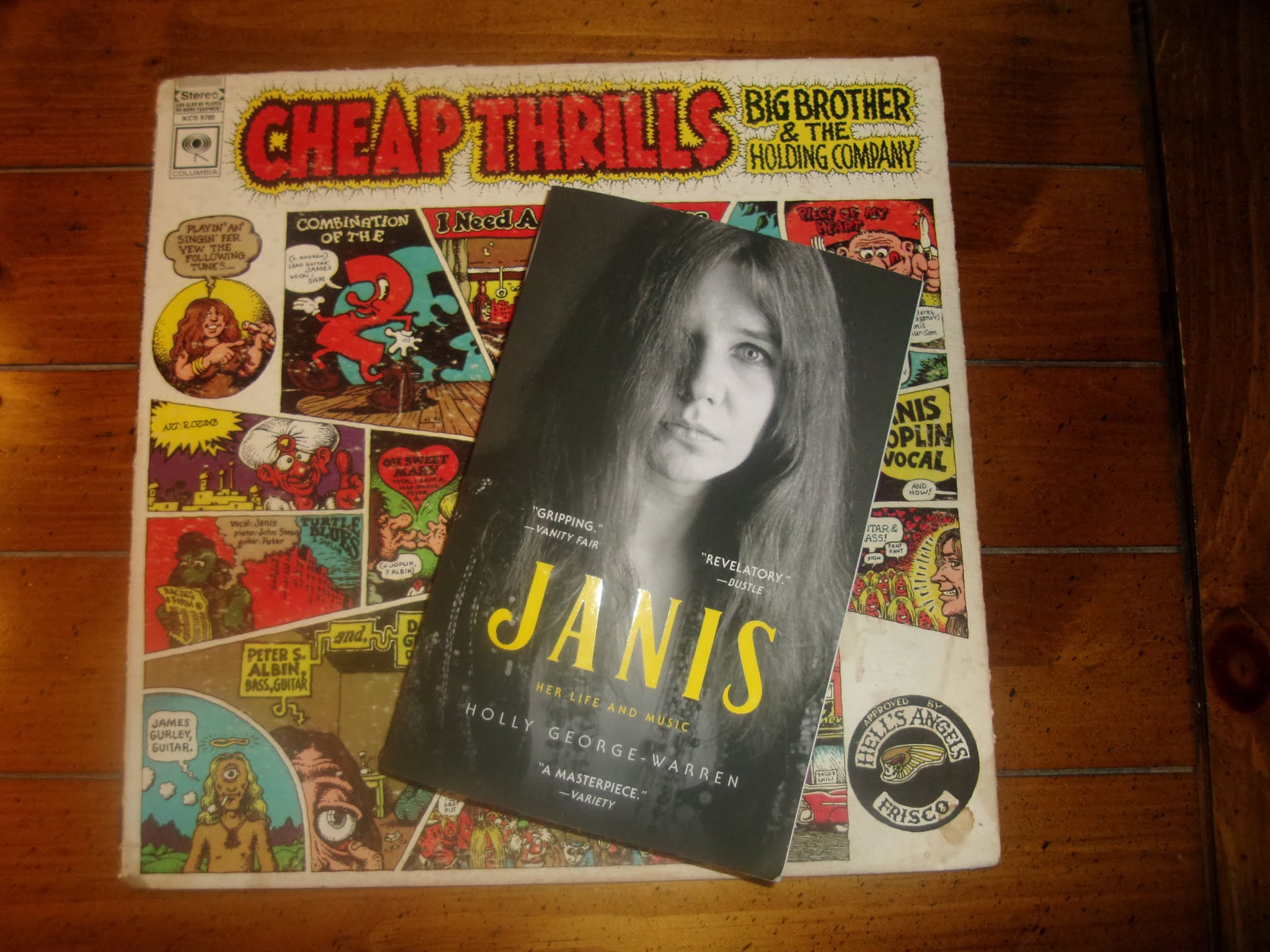
The second book was a biography of
someone whose voice frequently reached out from my stereo speakers in my youth.
Popular music in the 21st
century typically is polished, highly produced, visual, and choreographed. This
so unlike the 1960s when a frowzy Janis simply walked on stage and sang her
heart out. There is something about the romantic excess in her songs that
appeals especially to adolescents – and for once I don’t mean that as an
insult. It appeals to them because they are not cynical yet (much as they might
think otherwise) and all of that emotion looms fresh and huge; if we have a
little teenager left in us – again not meant as an insult – we still can
recapture a bit of that from singers like Janis.
A dark side to Janis – not unique to the
1960s – was substance abuse: notably Southern Comfort onstage and heroin
backstage. Southern Comfort is also something one tends to grow out of after
adolescence btw: too sweet and syrupy straight-up, but OK as a mixer with coke
or something. Like all liqueurs, it also gives mean hangovers – or so, ahem,
I’m told. Hangovers by themselves would have been survivable however. Janis
died in October 1970 from an overdose of unexpectedly pure (only 50%
adulterated) heroin.
George-Warren’s book covers the ground
one expects a bio to cover.. All biographers going back to Plutarch insert
their own perspectives into their narratives, and George-Warren does, too, but
not overly distractingly. (Autobiographers on the other hand, while their
perspectives can’t help but be their subject’s own, are more apt to outright
lie, especially by omission.) The book is well researched and details the wrinkles
of Janis’ lifeline. Yet, despite the much briefer account contained in it, I prefer
the memoir Laid Bare by actor/author
John Gilmore who knew the woman personally. Though he writes of Janis in only
one chapter, and intensely from his own perspective, we put the book down
feeling we’ve met the person – and have mixed feelings about having done so. A
third option is simply to let Janis speak for herself in her music. That works,
too.